


AI makes decisions. But who checks whether they actually work within one’s own supply chain?
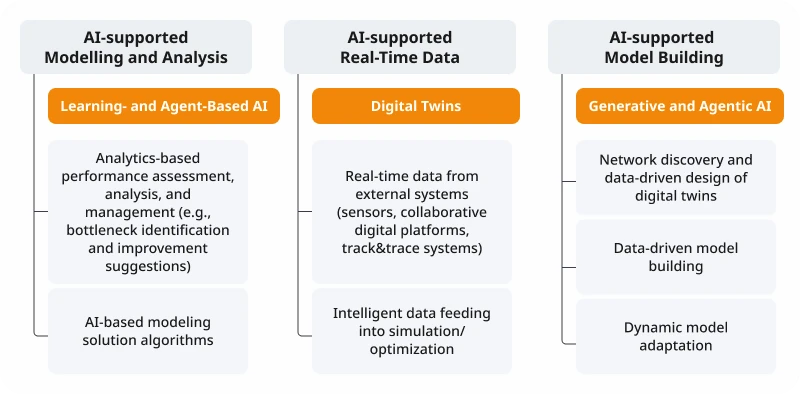
Simulation answers a fundamental question in supply chain planning: what happens if we change something? Artificial intelligence is currently transforming the way companies work with simulation models. Prof. Dr Dmitry Ivanov (Berlin School of Economics and Law) demonstrated at the anyLogistix Conference 2026 how simulation models can be turned into digital twins that AI agents will be able to use themselves in future.
Why AI does not replace simulation
Generative AI recognises patterns, formulates recommendations and can be operated using natural language. However, it cannot assess on its own whether a recommendation will work in a real-world network.
An example: an optimisation model delivers an attractive network configuration based on idealised assumptions. Only the simulation reveals how this configuration behaves under real-world delivery times, stock rules, fluctuating demand and operational constraints. The simulation thus becomes a testing ground for AI-supported decisions.
Three ways in which AI is transforming supply chain simulation
Communicating with the model
Questions such as “What are the benefits of an additional distribution centre?” or “How does the reorder point affect the service level?” are directly translated into experiments. This makes simulation accessible even to decision-makers who do not build models themselves.
Explaining results
AI evaluates simulation results, identifies anomalies and explains correlations. In Ivanov’s example, an AI assistant identifies unsuitable reorder points, explains the consequences for the service level and suggests alternative values.
Deriving scenarios from events
A specification such as ‘stress test against a global energy crisis’ is translated into a concrete disruption scenario, for example involving higher energy and transport costs, inflation and falling demand. The scenario is then run through the model.
Greater visibility beyond direct suppliers
Most companies are familiar with their own processes and their Tier 1 suppliers, but often know little about deeper levels of the supply chain. AI can help to gather information about the extended network. The simulation then shows what a disruption there would mean for the company’s own supply chain.
Who takes on which task?
In the architecture described by Ivanov, anyLogistix forms part of the operational analysis layer. The tasks are clearly allocated:
- Data systems such as ERP, TMS or WMS provide the current status.
- AI interprets data, recognises patterns and coordinates.
- Optimisation finds solutions within specified objectives and constraints.
- Simulation tests these solutions under realistic conditions.
- Experts provide context, set priorities and exercise control.
Practical implications
Much of this is still at the conceptual stage. One thing is clear, however: anyone wishing to use AI in supply chain planning in future will need robust models and a clean database. Without both, there is no basis on which to test AI recommendations.
Frequently asked questions
Does AI replace supply chain simulation?
No. AI makes models more accessible and helps to understand the results. Simulation continues to show whether a decision works under real-world conditions.
What is an agent-based digital twin?
A digital twin links a simulation model with real-world data. In an agent-based digital twin, AI agents use the model themselves, adapt scenarios and evaluate alternatives.
Support from SimPlan
SimPlan works closely with AnyLogic and supports companies in their use of anyLogistix, from building robust supply chain models to evaluating scenarios. Please get in touch if you would like to prepare your supply chain for simulation and AI.
Source: anyLogistix Blog, The future of supply chain simulation: digital twins and agentic AI, 28 September 2026