anyLogistix 3.4.2: Cost-to-serve as the key to transparent and profitable supply chain networks

anyLogistix_Cost to serve experiment settings and mode options

How the new release enhances supply chain optimisation through detailed network analysis and profitability assessment

Supply chain optimisation is often based on aggregated metrics such as total costs or average transport costs. Whilst this perspective is helpful, it often falls short.

This is because many economic inefficiencies do not arise at the network level, but in the details. This is precisely where the Cost-to-Serve concept comes in, which is given greater prominence in the latest release of anyLogistix 3.4.2.

Why traditional supply chain optimisation reaches its limits

In practice, many network analysis projects paint a similar picture:

  • The network is formally optimised
  • Total costs appear competitive
  • Strategic decisions are based on averages

Yet key questions remain unanswered:

  • Which customers are actually profitable
  • Which products incur disproportionately high costs
  • Which transport structures are economically viable in the long term

Studies and project experience show that often 20 to 30 per cent of customers are unprofitable, even though the overall network appears efficient.

The causes usually lie in:

  • individual ordering patterns
  • complex delivery requirements
  • unfavourable routes or small shipment sizes

These effects remain hidden in aggregated analyses.

Cost-to-serve analysis as an extension of network analysis

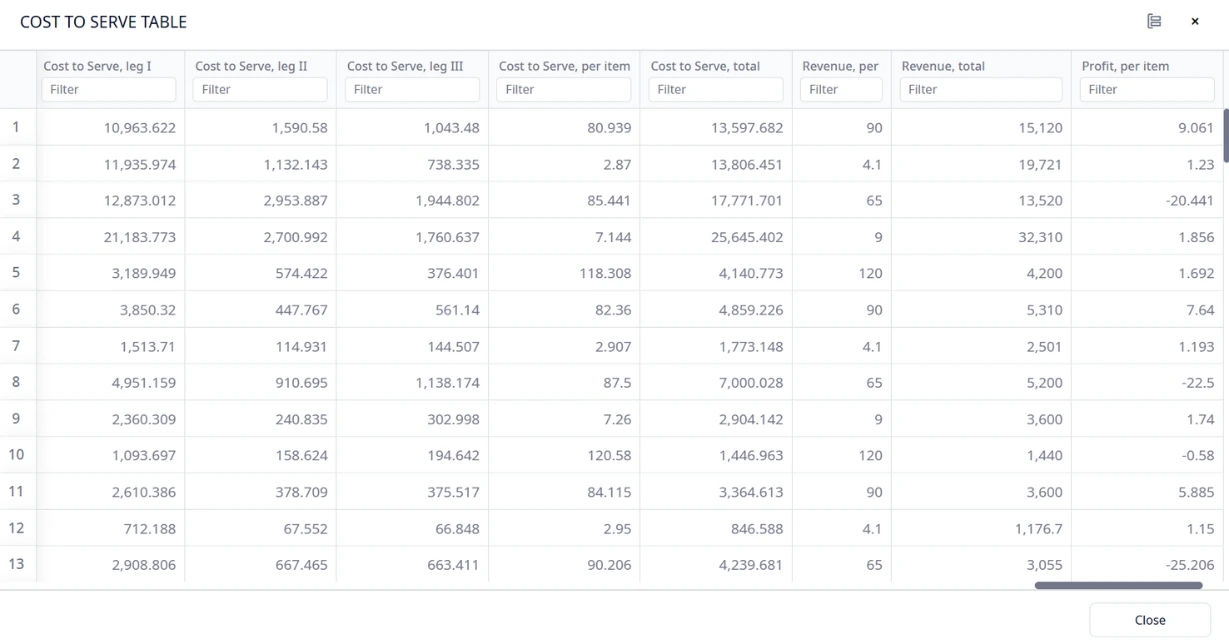
The cost-to-serve approach adds a crucial dimension to traditional supply chain optimisation: cost-based evaluation at the individual relationship level.

Instead of merely considering total costs, costs are allocated in detail along the entire supply chain:

  • per product
  • per customer
  • per transport route

This creates end-to-end transparency from source to destination.

Which costs are taken into account

A robust cost-to-serve analysis integrates various cost types:

  • Transport costs
  • Process costs
  • Production and procurement costs
  • Other operational costs

Revenues and margins are also included. This creates a consistent link between operational planning and financial evaluation.
Added value for supply chain optimisation

The combination of network and cost-to-serve analysis opens up new opportunities for data-driven decision-making.

1. Identification of unprofitable customers

Companies can identify which customer relationships are economically critical.

This enables targeted measures such as:

  • Adjustment of service levels
  • Revision of pricing structures
  • Optimisation of delivery concepts

2. Evaluation of product portfolios

Not every product contributes equally to profitability.

Through detailed analysis, it is possible to:

  • identify low-margin products
  • make more informed portfolio decisions

3. Transparency in transport structures

Analysis of individual transport chains reveals:

  • where costs arise along the route
  • which sections are particularly inefficient

This creates a basis for targeted network optimisation.

4. Linking planning and economic efficiency

A key advantage lies in the integration of:

  • physical material flows
  • operational decisions
  • financial results

This makes the supply chain not only efficient but also economically manageable.

Application in practice and projects

In many supply chain optimisation projects, a lack of detailed transparency proves to be a critical bottleneck.

Typical challenges:

  • Discussions about costs without clear attribution
  • Measures that do not address the actual cost drivers
  • Limited informative value of average figures

Integrating the cost-to-serve approach into network analysis helps to close these gaps.

From cost optimisation to profitability management

Traditional network analysis remains a central component of supply chain optimisation. However, it is only by supplementing this with cost-to-serve considerations that it becomes clear where value is created and where it is not.

This provides companies with a sound basis for:

  • strategic network decisions
  • operational optimisation measures
  • sustainable increases in profitability

Image source: The AnyLogic Company

Do you have any questions or would you like to optimise your supply chain? Contact us for a personalised consultation.

Our next webinar on SCM simulation and supply chain optimisation will take place on 23 April 2026 from 11:00 to 12:00 CET (or on request if required). We look forward to discussing your topics with you there!

Or contact our supply chain expert Till Fechteler directly for a personalised consultation regarding your supply chain.